Visit our exhibitions and events, enjoy our Sculpture Park and discover our online activities.
This year, the Sainsbury Centre is investigating how we can know what is true in the world around us through a series of fascinating, interlinked exhibitions – In Event of Moon Disaster, Liquid Gender, Jeffrey Gibson: no simple word for time and The Camera Never Lies – bringing together some of the world’s leading artists and creative thinkers, plus a new, interlinking publication.
17 February- 20 October 2024
Universal Ticket
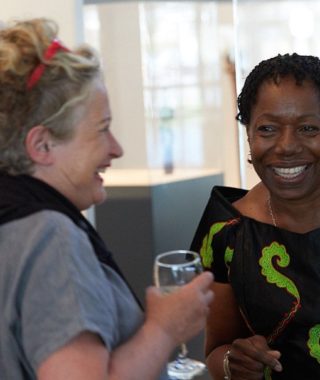
Sainsbury Centre’s Chief Curator of Art, Tania Moore, will be in conversation with artist Ro Robertson.
25 April- 25 April 2024
Book now
An Emmy Award-winning interactive experience that is a deep dive into misinformation and conspiracy. Using AI to tell an alternative history, the show brings to light how an event as influential as the 1969 Apollo 11 moon landing could be manipulated, and how doubt can be cast on even the most well-known of facts.
17 February- 4 August 2024
Universal Ticket
Immerse yourself in a guided sensory experience. In collaboration with a trauma therapist and migrating birds, Memory of Birds is an interactive sound installation in the trees. The work explores political violence that both literally and figuratively gets buried in contested lands.
16 May- 18 May 2024
Book now
Immerse yourself in our content hub, exploring the life stories of our living collection.
Since our relaunch in 2023, visitors can choose from a range of digital, analogue and experiential pathways to build new relationships with art in the museum.
SEE MORE
Sainsbury Centre director Jago Cooper gives an introduction to our new season of exhibitions exploring 'What Is Truth?', which commenced in February 2024.
SEE MORE
In this interview, Sophie, LGBT rights activist and sea swimmer, talks to us about their relationship with gender and the natural world in response to Ro Robertson’s piece, ‘Stack (Body Set in Motion)’.
SEE MORE
Sharing Stories empowers you to choose the voice of the artwork you want to listen to. Holding up your camera phone to any artwork on display, the image recognition app Smartify instantly brings up when this artwork was born and its life story.
SEE MORE